Thailand launches its first National Action Plan on Women, Peace and Security
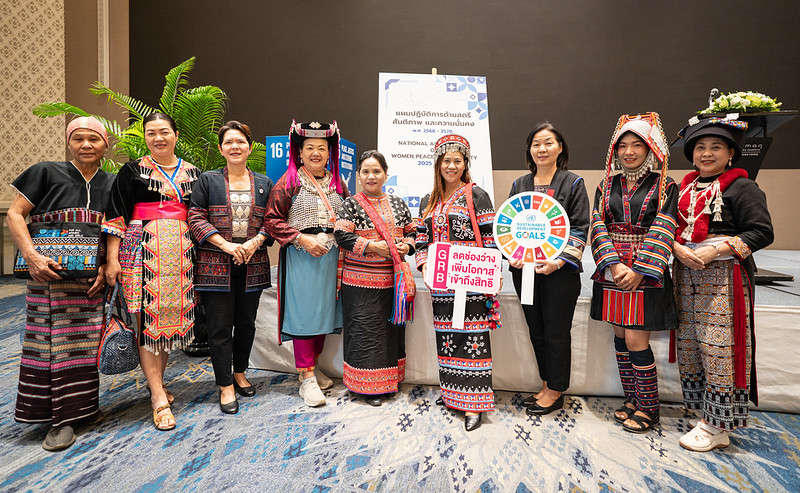
Bangkok, Thailand — The Royal Thai Government, through the Ministry of Social Development and Human Security (MSDHS) and Ministry of Foreign Affairs, in partnership with UN Women, officially launched Thailand’s first National Action Plan on Women, Peace and Security (NAP WPS) today, marking a historic milestone in the country’s commitment to gender equality, inclusive security and sustainable peace.
With this move, Thailand becomes the 15th country in the Asia-Pacific region, and the 116th country globally, to adopt a NAP WPS aimed at achieving the full and equal representation and participation of women in all levels of peace and security efforts.
The launch was followed by an orientation workshop for line ministries to strengthen readiness for nationwide implementation.
The NAP WPS advances the country’s obligations under Convention on the Elimination of All Forms of Discrimination against Women, the 2030 Agenda for Sustainable Development, the ASEAN Regional Plan of Action on WPS, UN Security Council resolution 1325 and subsequent resolutions. The Plan was developed from 2022 to 2024 through an inclusive, multi-stakeholder process involving government agencies, women’s groups, youth, academia, civil society organizations (CSOs) and community leaders across the country, including regional public hearings with the support of UN Women.
It was approved by the National Committee on Policy and Strategy for the Development of the Status of Women on 5 November 2025.
“This Plan was shaped by the voices of women, youth, community leaders and partners across the country to equip us to respond more effectively to current challenges, whether related to conflict, violence, crises or digital threats, while ensuring women’s leadership and protection remain at the forefront of our national agenda,” said Jatuporn Rojanaparnich, Director-General of the Department of Women’s Affairs and Family Development, Ministry of Social Development and Human Security.
Thailand’s NAP WPS strengthens and expands earlier national efforts, including the Measure and Guideline on WPS (2017–2021) and the Coordination Center for Children and Women in the Southern Border Provinces.
Thailand’s NAP WPS is built around four priority pillars aligned with the global WPS framework:
- Participation – Enhancing women’s leadership and meaningful participation in peacebuilding, conflict prevention, policymaking and security mechanisms
- Protection – Strengthening legislation, services and multisectoral responses to protect women and girls from all forms of violence, especially amid conflict and insecurity
- Prevention – Addressing root causes of conflict and gender-based violence through early-warning systems, social cohesion, community resilience and data-driven risk mitigation
- Relief and recovery – Ensuring gender-responsive crisis management, humanitarian support and long-term recovery efforts, including in border and conflict-affected areas.
In parallel with the NAP development, UN Women and the Department of Women’s Affairs and Family Development supported the establishment of WPS Networks, WPS Focal Points and Women’s Empowerment (WE) Centres across Thailand’s border provinces. These platforms support coordination between women leaders, CSOs and local governments, and enable communities to meaningfully contribute to NAP implementation and monitoring. To date, four regional WPS Networks and nine WE Centres have been established in the Southern, Northern, Eastern and North-Eastern border regions, strengthening local capacities for conflict prevention, social cohesion, digital safety and crisis response.
“The launch of this National Action Plan reflects Thailand’s dedication to advancing security and peace through inclusive and gender-responsive approaches,” said Christine Arab, UN Women Regional Director for Asia and the Pacific. “Its strength lies in how it was built – through collaboration with women leaders, community networks, line ministries and civil society across all regions. UN Women is honoured to accompany Thailand on this journey.”
Over 20 line ministries and national bodies are assigned roles within the NAP WPS, including those responsible for justice, security, digital governance, environment, public health and social development. The orientation workshop will introduce ministries to the NAP WPS’s expected results, implementation responsibilities, and reporting mechanisms to ensure coordinated and effective national execution.
The NAP WPS also emphasizes partnerships with civil society, women human rights defenders, youth organizations and community groups – as well as collaboration with international partners including Australia, Canada, Republic of Korea and the United Kingdom – whose support contributed to localizing the WPS agenda and strengthening institutional capacities across Thailand.
For media inquiries:
Montira Narkvichien
Head of Communications, UN Women Asia and the Pacific
E: montira.narkvichien@unwomen.org